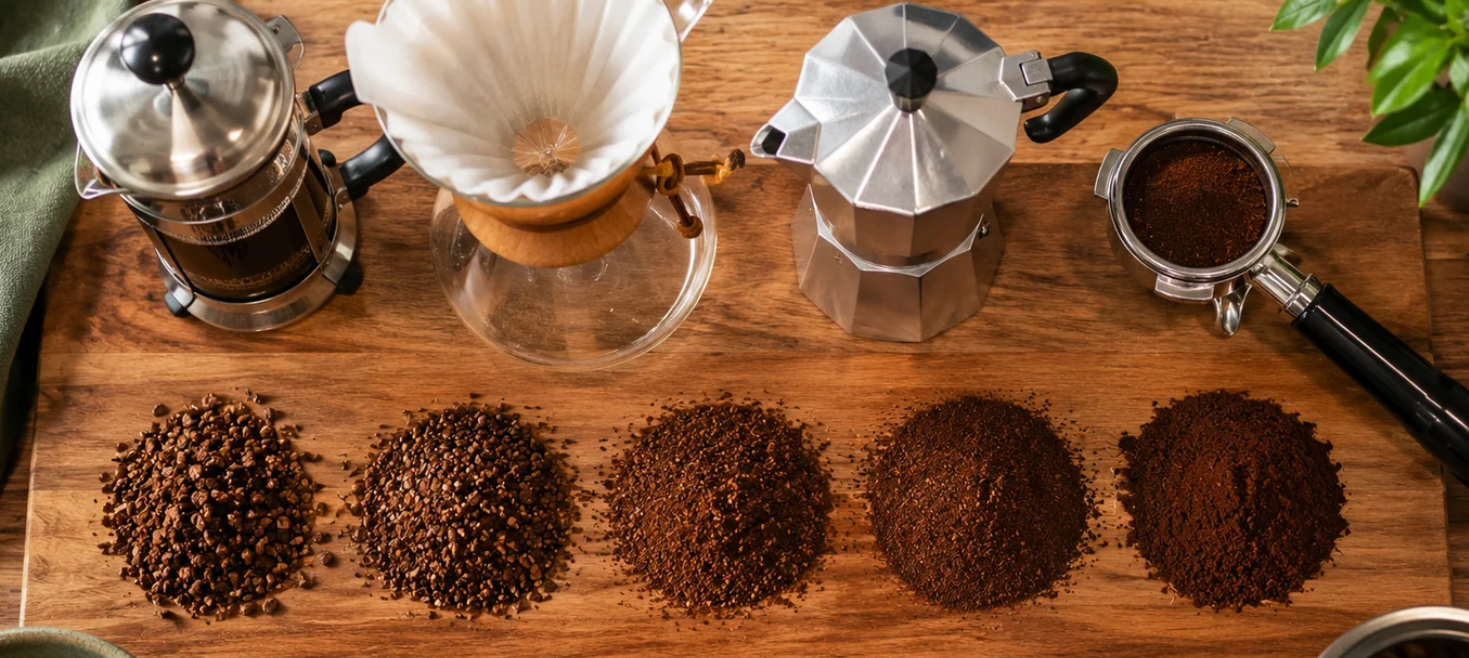
The Master Control: How Grind Size Shapes Coffee Taste
While water temperature and brew ratio establish the foundational recipe, grind size acts as the steering wheel of coffee flavor. It is the primary mechanical lever used to control extraction—the physical process of dissolving acids, sugars, aromatics, oils, and bitter compounds from the solid coffee matrix into your cup
The Physics: Surface Area and Flow Dynamics
Grind size physically controls how water behaves inside your coffee bed through two primary mechanisms:
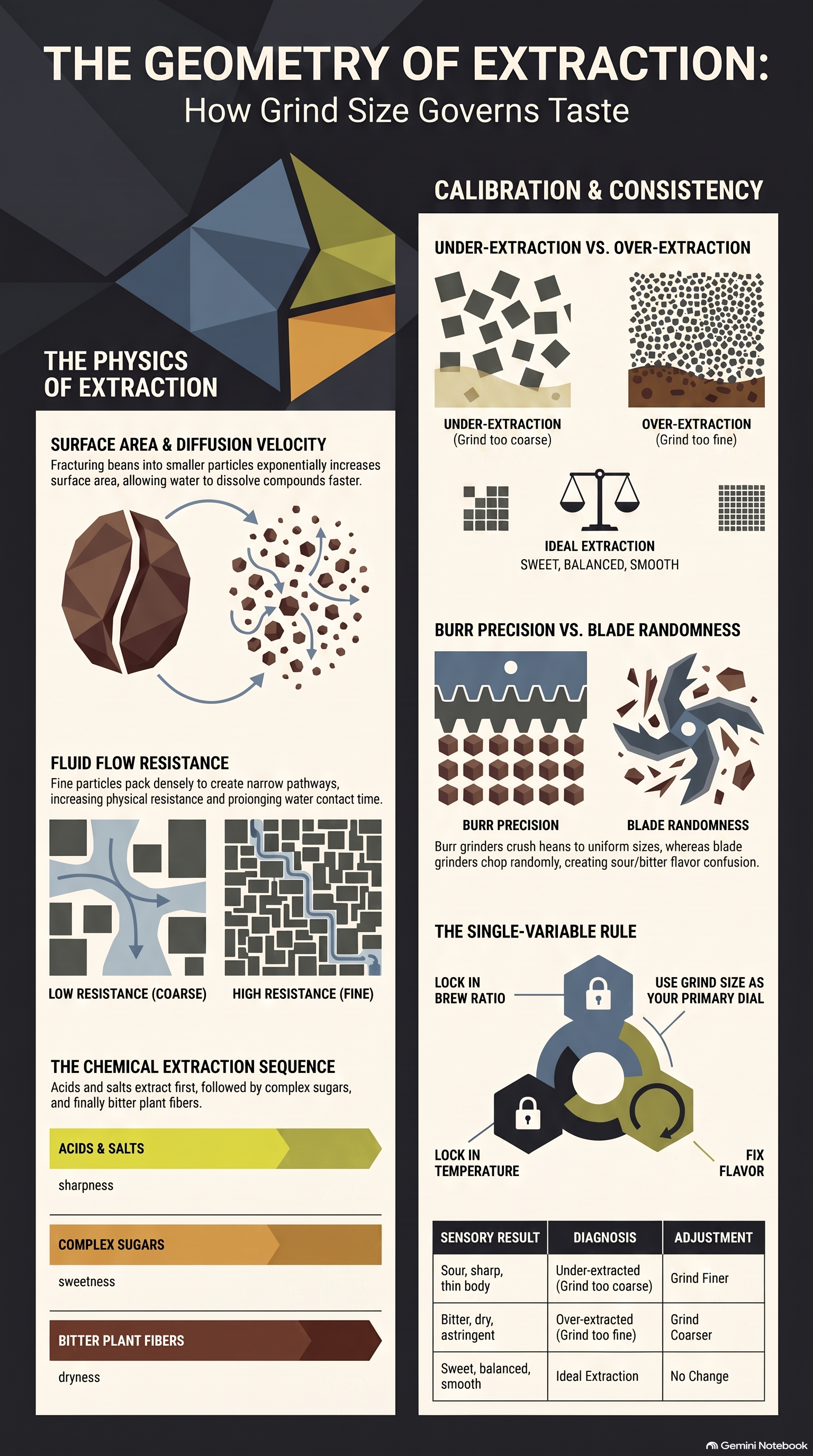
Surface Area Exposure: When a coffee bean is fractured into smaller particles, its total exposed surface area increases exponentially. A fine grind exposes a massive surface area and shortens the diffusion distance, allowing water to quickly penetrate the shallow depth of each particle and accelerate extraction. A coarse grind exposes a much lower surface area and increases the diffusion distance, requiring water to travel deeper to dissolve flavors, which slows down extraction
Water Flow Resistance: Ground particles also act as a physical barrier to water. Fine particles pack tightly together, creating narrow interstitial gaps that restrict fluid pathways, slow water flow, and prolong contact time. Coarse grounds leave wider channels, allowing gravity to pull water through the bed rapidly, which reduces contact time
The Chemistry: The 3 Stages of Extraction
Soluble compounds do not dissolve all at once; they extract in a highly predictable sequence:
Early Stage (Acidity & Aromatics): Bright organic acids, floral/citrus notes, and light aromatics dissolve first. These provide your coffee's initial freshness, energy, and fragrance. If extraction ends prematurely, the cup tastes sour, sharp, thin, and hollow.
Middle Stage (Sweetness & Balance): Natural sugars, caramelized sweetness, and body-building compounds dissolve next. This is the ideal "sweet spot" where flavors integrate, acidity softens, and the cup develops clear sweetness and full mouthfeel.
Late Stage (Bitterness & Structure): Heavier bitter compounds, woody/earthy notes, and astringent tannins dissolve last. While a tiny amount provides structure and finish, extracting too much late-stage material results in a harshly bitter, dry, and heavy cup.
Diagnosing Your Taste Spectrum
Because compounds dissolve at different speeds, your grind size directly determines which extraction stage dominates the cup:
Too Coarse (Under-Extraction): Water passes through too quickly to dissolve slow-yielding sugars and oils. Acidity dominates, and the cup tastes sour, sharp, weak, and watery.
Too Fine (Over-Extraction): Water moves too slowly and lingers too long, pulling out undesirable late-stage plant fibers. Acidity is muted, and the coffee tastes harshly bitter, dry, and astringent, leaving a chalky sensation on your tongue.
Just Right (Balanced Extraction): Acidity is lively but gentle, sweetness is clear, bitterness stays in the background, and the body feels satisfying
Why Consistency is Crucial
Your grind setting is only as good as your grinder's ability to produce a uniform particle size.
The Problem with Inconsistent Grinds: If your grinder chops unevenly (like a blade grinder), it produces a mix of microscopic dust ("fines") and massive chunks ("boulders"). In the same brew, the fines will over-extract (injecting harsh bitterness) while the boulders under-extract (injecting hollow sourness). You taste both defects simultaneously, resulting in a cup that is confusingly astringent and highly acidic at the same time.
The Burr Grinder Advantage: Unlike blade grinders that chop randomly, a burr grinder crushes beans between two abrasive surfaces set a fixed distance apart. This delivers a highly uniform, repeatable particle size, allowing you to make precise, deliberate adjustments to target the perfect flavor profile every time.