Master Your Home Brew: The Ultimate Coffee-to-Water Ratio Guide
Mornings move fast…..kids, inboxes, the drive ahead.
Coffee is the one part of the routine that asks you to stop for a minute, and it deserves to be good when you do. The single biggest thing standing between a decent cup of coffee and a truly spectacular one isn't an expensive machine or an exotic bean. It is the brew ratio: how much coffee you use in relation to your water. Getting this simple relationship right takes the guesswork out of your morning ritual, giving you a consistently delicious cup every single morning.
Why a Digital Scale Beats a Scoop
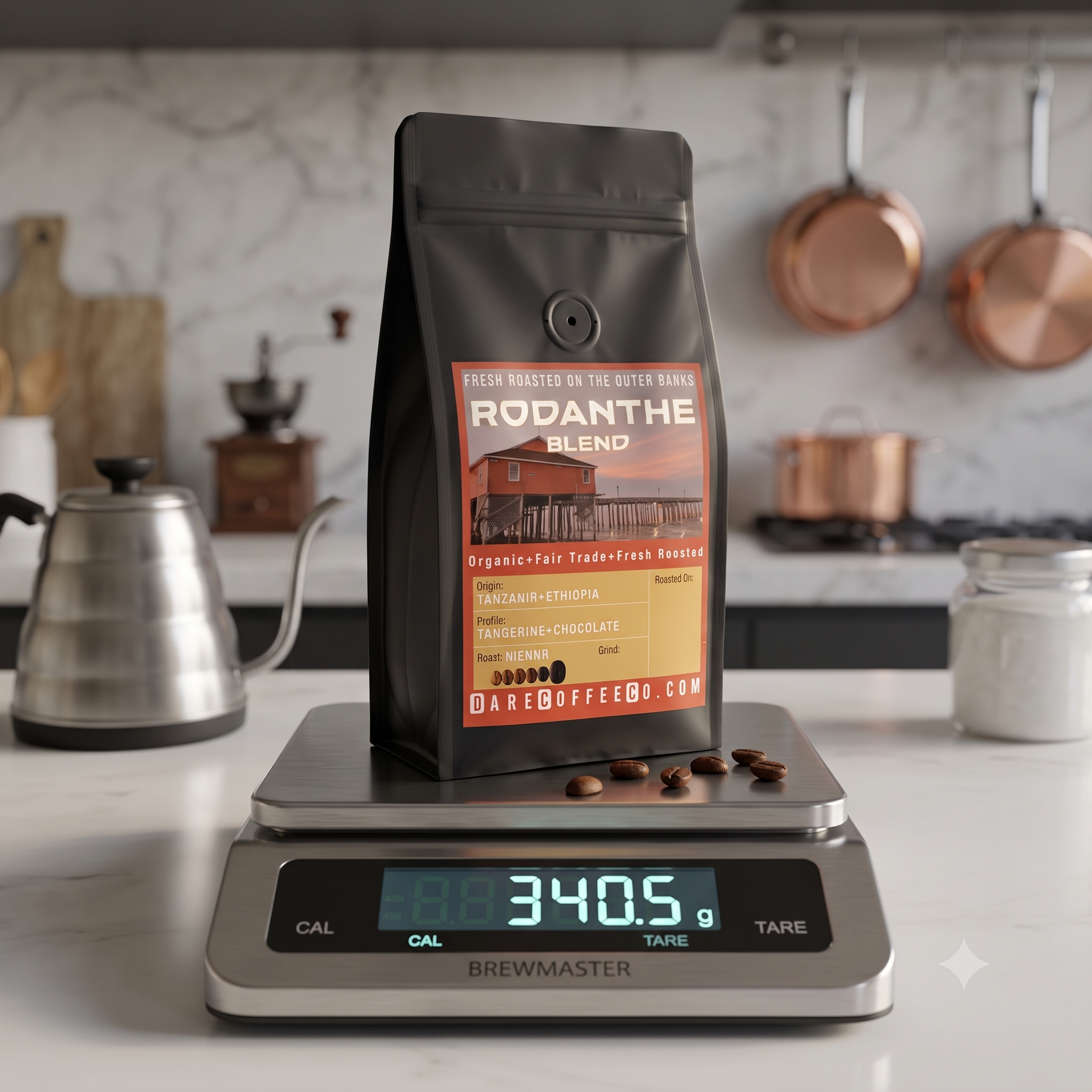
Using a scoop or a tablespoon is convenient when you are in a rush, but volume-based measurements are notoriously inconsistent. Coffee beans vary wildly in density depending on their origin, bean type, roast level, and how compact they are in your spoon. A light, airy roast weighs less than a scoop of a dense, dark roast, meaning you get a different amount of coffee every single time.
Weighing both your coffee grounds and your water in grams on a simple digital scale guarantees absolute consistency. Because 1 gram of water equals exactly 1 milliliter, the math is incredibly clean and straightforward. Precision weighing is the difference between getting lucky with a great cup today and being able to repeat that exact same perfect flavor tomorrow.
What is a Coffee-to-Water Ratio?
A brewing ratio is simply the relationship between the weight of your dry coffee grounds and the weight of your brewing water. It is represented as a format like 1:x, where: 1 represents 1 gram of coffee. X represents the grams (or milliliters) of water. For example, a 1:16 ratio means you will use 1 gram of coffee for every 16 grams of water
The Math is Easy: If you want to brew with 20 grams of coffee using a 1:16 ratio, simply multiply your coffee weight by the ratio number: 20g coffee times 16 = 320g of water. This allows you to scale your recipe as big or as small as you want while keeping the exact same delicious flavor results!
Different brewing methods require slightly adjusted ratios to account for extraction variables like contact time, grind size, and pressure.
Find your favorite method below to dial in your recipe:
| Brewing Method | Recommended Ratio | Profile & Taste Notes |
|---|---|---|
| Chemex | 1:15 | Highly delicate and bright due to thick paper filters |
| French Press | 1:15 | Immersion method; a tighter ratio balances extraction. |
| Auto-Drip Machine | 1:16 | Your reliable, classic morning drip brewer |
| AeroPress (Standard) | 1:15 | Fast, versatile extraction using manual pressure |
| Cold Brew (Ready-to-Drink) | 1:11 | Extremely smooth, sweet, and low-acid profile |
| Cold Brew Concentrate | 1:5 | High-strength extract; dilute 1:1 with water or milk |
| Espresso | 1:2 | Intense, concentrated, and crowned with rich crema. |
| Moka Pot | 1:10 | Bold, heavy-bodied, espresso-like stovetop brew |
| Turkish Coffee | 1:10 | Unfiltered and simmered; rich, deep, and traditional |
Quick-Start Batch Recipes (1:16 Standard Ratio)
If you only remember one number, make it 1:16. It is the ultimate golden starting point for almost any coffee and any brewer.
Here is exactly how much coffee and water to prepare for common serving sizes, rounded to the nearest whole gram so you don't have to chase decimals at home :
Single-Serve / Small Pour-Over (About 250 ml water): Use 16 grams of coffee.
One Standard Mug (About 350 ml water): Use 22 grams of coffee.
Two Standard Mugs (About 500 ml water): Use 31 grams of coffee.
Full French Press / Carafe (About 1,000 ml water): Use 62 grams of coffee.
💧 Pro Web Tip: Note that the water quantity is the input, not the output. Because dry coffee grounds naturally absorb about double their weight in water during brewing, your final cup will yield slightly less liquid than the total water you poured in.
No Scale? No Problem! (The Tablespoon Method)
While we always recommend a digital scale for consistency, you can still brew a fantastic cup using standard kitchen utensils in a pinch:
The Coffee: 1 level tablespoon of ground coffee weighs approximately 5 to 6 grams.
The Water: 1 standard liquid cup is 8 fluid ounces (approximately **240 milliliters**).
The Spoon-to-Cup Formula: To brew close to a 1:16 ratio without a scale, use 2 level tablespoons of ground coffee for every 8-ounce cup of water.
If you are using a standard multi-cup home drip machine and don't want to weigh your water, a great rule of thumb is 2 tablespoons of coffee for every 6 ounces of water, and then adjust to your taste from there.
-
The Cause: Your coffee is likely under-extracted.
The Fix: You can increase the strength by using a tighter ratio (try 1:14 or 1:12) or grinding your coffee slightly finer to slow down the water flow and extract more flavor.
-
The Cause: Your coffee is likely over-extracted.
The Fix: You can mellow out the brew by using a wider ratio (try 1:18 or 1:20) or grinding your coffee slightly coarser to speed up the water flow and prevent over-extraction.
-
The Rule: Coarser grinds allow water to pass through quickly, yielding lower extraction. Finer grinds restrict water flow, creating more contact time and yielding a higher extraction. Think of water flowing through coarse rock salt versus fine sand!
-
The Rule: Lighter roasts benefit from a slightly finer grind size and higher water temperature. Darker roasts benefit from a slightly coarser grind size and lower water temperature to avoid extracting bitter flavors.
-
The Rule: Absolutely! Your brewed cup is over 98% water. Hard, soft, or distilled water can heavily alter the extraction process and muddy the flavor. For the best results, always use freshly filtered water
Fresh Coffee Makes the Process Forgiving. The fresher the roast and the closer to brewing you grind, the more delicious and forgiving the whole process becomes .
You don’t need to turn your kitchen into a lab, just start with a scale, aim for a 1:16 ratio, and let your taste buds guide you .